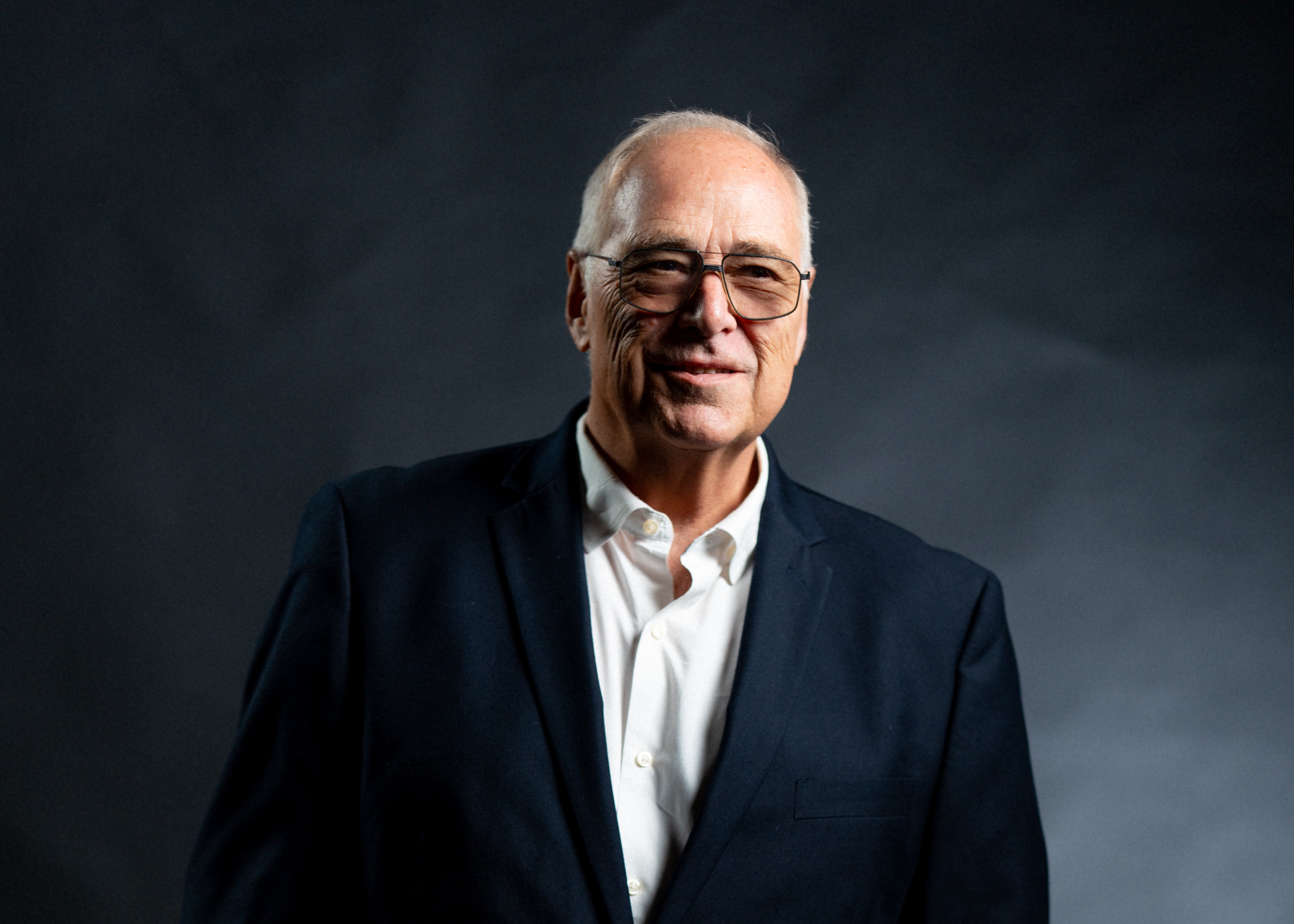
Michael Minkler, Three-Time Oscar-Winning Master of Film Sound
Star Wars was a turning point in my half-century career
Interview by Josip Grozdanić
Originally published in Vijenac
In mid-October, the 13th International Sound & Film Music Festival took place in Samobor and Varaždin. The festival, dedicated to raising awareness of the importance of music and sound as indispensable elements of cinema, once again hosted several distinguished figures from the world of film. Among them was Michael Minkler, an American sound designer and three-time Academy Award winner. With a career spanning more than five decades, collaborations with many major directors and film stars, and a reputation as an engaging, articulate, and witty conversationalist, Minkler gladly agreed to speak with Vijenac.
You have won the Academy Award three times, from a total of 13 nominations. The first was for Best Sound on Ridley Scott’s Black Hawk Down (2002). From a viewer’s perspective, that seemed like an extremely demanding job. You had to synchronize gunfire, explosions, soldiers shouting—and then a moment when one soldier goes deaf and hears nothing around him. How challenging was that project for you?
Overall, it was extremely demanding. It was perhaps the most difficult—or rather the most challenging—project I have ever taken on, especially because of the many scenes involving warfare and explosions. The sound recorded on set in such situations is unusable due to the sheer amount of gunfire and noise. This meant that over roughly a hundred minutes of combat, all dialogue had to be replaced in post-production.
For that purpose, we use ADR, a technique that allows dialogue to be re-recorded later in controlled studio conditions. These recordings are then seamlessly integrated into the film so that audiences don’t notice anything. ADR work always involves a tremendous amount of work, because all sound effects have to be redesigned and recorded again.
The scene you mentioned—when the soldier goes deaf after an explosion—gave us the most trouble. At that point, he hears nothing, but the audience has to hear absolutely everything happening around him. Since none of us had ever experienced something like that ourselves, we could only imagine what it might sound like. We spoke extensively with people who had gone through similar experiences, and they tried to describe as vividly as possible the sounds they heard in those moments.
We came up with the idea that at one point there would be complete silence—that all sounds would drop out entirely—and then, gradually, the ringing, the noise, and the surrounding cacophony would return. We had to convey the sounds as he experiences them, as they are generated by his eardrums. In the end, those effects, which required a great deal of effort and work, last less than a minute in the film—around 45 seconds—until his hearing returns to normal.
You won your second Oscar the following year, again for Best Sound, for Rob Marshall’s musical Chicago. That is a completely different genre, full of music, singing, and dancing in the spirit of vaudeville. Was working on it demanding?
It was very demanding. Most audiences think it’s easier to work on musicals than on action films, but that simply isn’t true. Musicals are extremely complex, because the entire material has to be handled with exceptional care—especially the singing and performances on set.
Of course, we always record performances live. But there are also recordings made during pre-production—tracks the actors recorded before arriving on set. There is also music recorded before filming begins. All of this material is extremely useful and also serves as a guide for how the final sound should ultimately be shaped.
Then comes the recording of live performances on set, followed by separate recordings of individual vocals on set, and finally complete re-recordings of the music in post-production. In the end, we use all of it—recordings of varying quality—with the goal of combining them into the best possible performance. This is especially true for vocals, which are the most delicate element.
Your third Oscar, this time for Best Achievement in Sound Editing, came in 2007 for Bill Condon’s Dreamgirls, a musical drama starring Beyoncé, Jamie Foxx, and Eddie Murphy. What do you remember about working on that project?
I remember it as being fun, because the material itself offered many opportunities for enjoyment. The performances were fantastic, both musically and dramatically. That film wasn’t as challenging as Chicago, mainly because everything was strictly and clearly defined.
There was a concrete story with strong dramatic intensity, which meant intense acting performances and complete immersion by the actors. That gave me the opportunity to play with sound—working with details characteristic of individual vocal qualities, as well as with the music itself. I made the most of that opportunity and tailored the sound to each performer.
When all the work was finished, a special screening was held, and many of the actors openly expressed their enthusiasm—not only for their vocals and performances, but also for the quality of the instrumental sections and the overall sound. It’s a film with a simple but very engaging story, and it was a real pleasure for me to work on it.
Your career spans more than half a century. You’ve worked on many acclaimed and cult films—among them The Exorcist (William Friedkin), The Shootist (Don Siegel), The China Syndrome (James Bridges), The Long Riders (Walter Hill), and even Star Wars: Episode IV – A New Hope. Which films stayed with you the most, and why?
You mentioned many that remain dear to me. Star Wars, of course, because it was unforgettable. Working on that film was a turning point in my career. At the time I was only 24 years old, and I was given the opportunity to do revolutionary things. In post-production, we did many things that had never been done before. We used technology in ways it had never been used before.
That was exactly what George Lucas wanted—that we should be the first to use certain techniques and invent new ones. In The Shootist, the legendary John Wayne played his final role. Symbolically, he portrayed a man dying of cancer at a time when he himself was battling cancer. Because of him, I will remember working on that film for the rest of my life.
The China Syndrome was also unforgettable, because it is the only film I’ve worked on that has no traditional film music. We didn’t decide that right away. After filming ended, we held an internal screening of the footage and asked ourselves whether the story needed music at all. It’s a film of strong dramatic intensity, with many pauses and moments of mystery. We removed the music and were surprised to discover the film worked perfectly without it.
Examples like that best demonstrate the power of sound in cinema, independent of music. Sometimes you don’t need a score at all—voices, ambient sounds, and sound effects can be enough to create intense tension.
Another film I remember fondly is Oliver Stone’s JFK. That project involved a great deal of demanding work, but it had to be that way because sound is extremely important in that film. We had to combine sound effects and dialogue with film music to construct a dramatic intensity that lasts throughout the entire running time—two hours and forty-five minutes.
There is an enormous amount of dialogue in JFK, sometimes even three overlapping layers. Viewers are constantly given so much information that you might think there is no room for music, or that it would only distract from what the characters are saying. We tried doing everything without music, but that made things worse.
Without music, audiences would struggle to follow the story and the flood of information. Music helps guide viewers through the narrative. By carefully adding music and sound effects, we managed to make the film even more intense and engaging. These examples show how sound can function in very different ways—shaping tone, dramatic intensity, and the audience’s emotional experience.
On JFK, you worked with director Oliver Stone. How would you describe him, both professionally and personally?
I made five films with Oliver. Working with him always brings surprises. He is a very interesting and demanding person, and I respect him greatly for that. He is a brilliant storyteller and approaches his work with tremendous passion.
He is also an excellent screenwriter, and his collaborators respect him deeply. That’s why he is able to bring out the best in everyone—not only actors, but cinematographers, editors, and all members of the creative team. His films are powerful and provocative.
The most important thing I took from working with him is passion for the craft. He encouraged us to develop new ideas and to push ourselves further. From him, I learned that every shot has its own value. Each shot tells a story, and there must always be a reason why it appears at a specific moment in a film.
Were there directors whose artistic sensibility was closer to yours, and how important is that in your work?
I worked on several films with Walter Hill and Ridley Scott. They work in a similar way: they explain what they want, clearly articulate the key details, and then let us do our work. When everything is finished, they review it carefully and decide whether they are satisfied.
If not, we explore alternative approaches. They allow experimentation and welcome ideas, while still making the final decisions. They are artists who value precision and want the best possible result. When I work with them, I accept the challenge and adapt as much as I can.
You have worked on all Quentin Tarantino films from Jackie Brown onward, including Kill Bill: Vol. 1, Kill Bill: Vol. 2, Death Proof, Inglourious Basterds, The Hateful Eight, and Once Upon a Time in… Hollywood. How do you experience working with him?
Working with Quentin always involves surprise and fun. He loves cinema and his characters, which he writes himself. When he’s smiling on set, we know everything is going well. When he stops smiling, something isn’t right.
His scripts are intense, dynamic, and full of outstanding dialogue. His films are like houses carefully built from foundation to roof. We have creative freedom, as long as we stay within the world he has created. I always adapt to directors—I never impose my own ideas in a way that would undermine the collective effort.
You’ve worked with many different directors, from Peter Bogdanovich (Nickelodeon) and Sydney Pollack (Bobby Deerfield), to Clint Eastwood (The Gauntlet) and Paul Schrader (Hardcore), as well as Richard Rush (The Stunt Man) and Robert Altman (Popeye). How challenging is it to adapt to such different personalities?
Sometimes it’s quite difficult. I move from one project to another very quickly, and each film comes with a new director, cast, and creative environment. I have to understand how people think and earn their trust.
Every new film requires building mutual trust. Once that trust exists, everything becomes easier. When everyone believes in one another, great work can be done.
Have any directors particularly influenced how you see film and your own work?
I feel privileged to have worked with some of the greatest directors. James Cameron, in particular, changed not only how I work, but how I see myself. His dedication goes far beyond meticulousness—he is completely immersed in every detail of the process.
You can learn enormously from that intensity, although not everyone can handle it. Overall, however, my experiences have been overwhelmingly positive.
When you compare Hollywood of the 1970s, 1980s, and 1990s with today, how much has it changed?
It’s completely different—mainly because of technology. None of the tools I use today existed in the 1970s or 1980s. Back then, sound design was manual work. Today, technology allows us to do almost anything we once imagined.
That’s why I’ve recently decided to revisit and remaster the sound of films I worked on in the past. In the streaming era, high-quality images must be matched by equally high-quality sound. Some things that sounded good in 1976 simply don’t sound that good in 2026.